
The Schedule Adjustment module now supports configurable Pre-Shift Value and Post-Shift Value fields. These fields set how many hours before a shift starts, and after a shift ends, that time logs are still counted toward that day's attendance.
Previously, every schedule used the same system default — currently configured on the backend as 2 hours before shift start and 12 hours after shift end (used as the example throughout this guide). Employees on straight-shift or extended-duty schedules who worked beyond that default had their extra hours dropped from the attendance record entirely, which could cause incorrect absences, incorrect pay deductions, and overtime missing from payroll.
This guide explains what the fields do, who can configure them, how to set them correctly, and the rules that govern where they apply.

Key Terms
- Pre-Shift Value (“Pre hours”): The number of hours before the scheduled shift start during which a time log is still counted toward that day.
- Example: Shift Start is 08:00 AM, Pre hours = 4. A clock-in as early as 04:00 AM is attributed to that shift day.
- Post-Shift Value (“Post hours”): The number of hours after the scheduled shift end during which a time log is still counted toward that day.
- Example: Shift End is 05:00 PM, Post hours = 17. A clock-out as late as 10:00 AM the next day is attributed to that shift day.
- Overtime-Detection Window: The total time window created by combining Pre-Shift and Post-Shift values around a shift. Time logs inside this window are evaluated for attendance and overtime for that shift day.
Who Can Configure This
- Managers
- HR Administrators
- Super Admins
Where to Find It

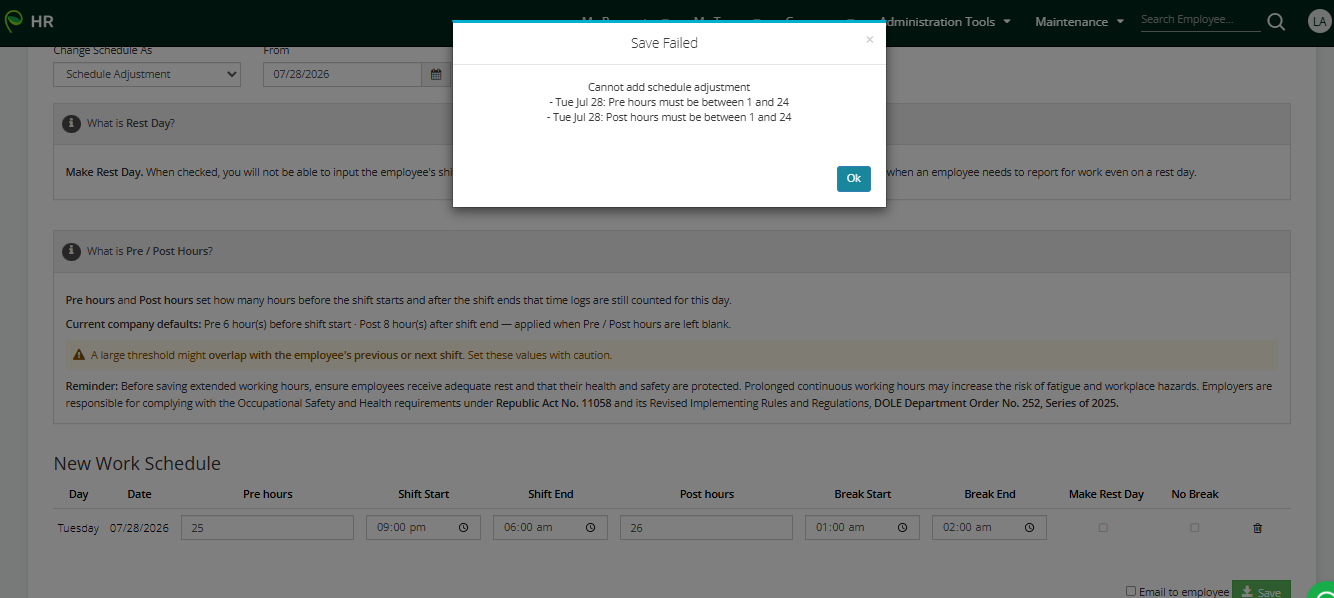
The Pre hours and Post hours fields appear as editable columns in the New Work Schedule table, alongside Shift Start, Shift End, Break Start, and Break End for each scheduled day.
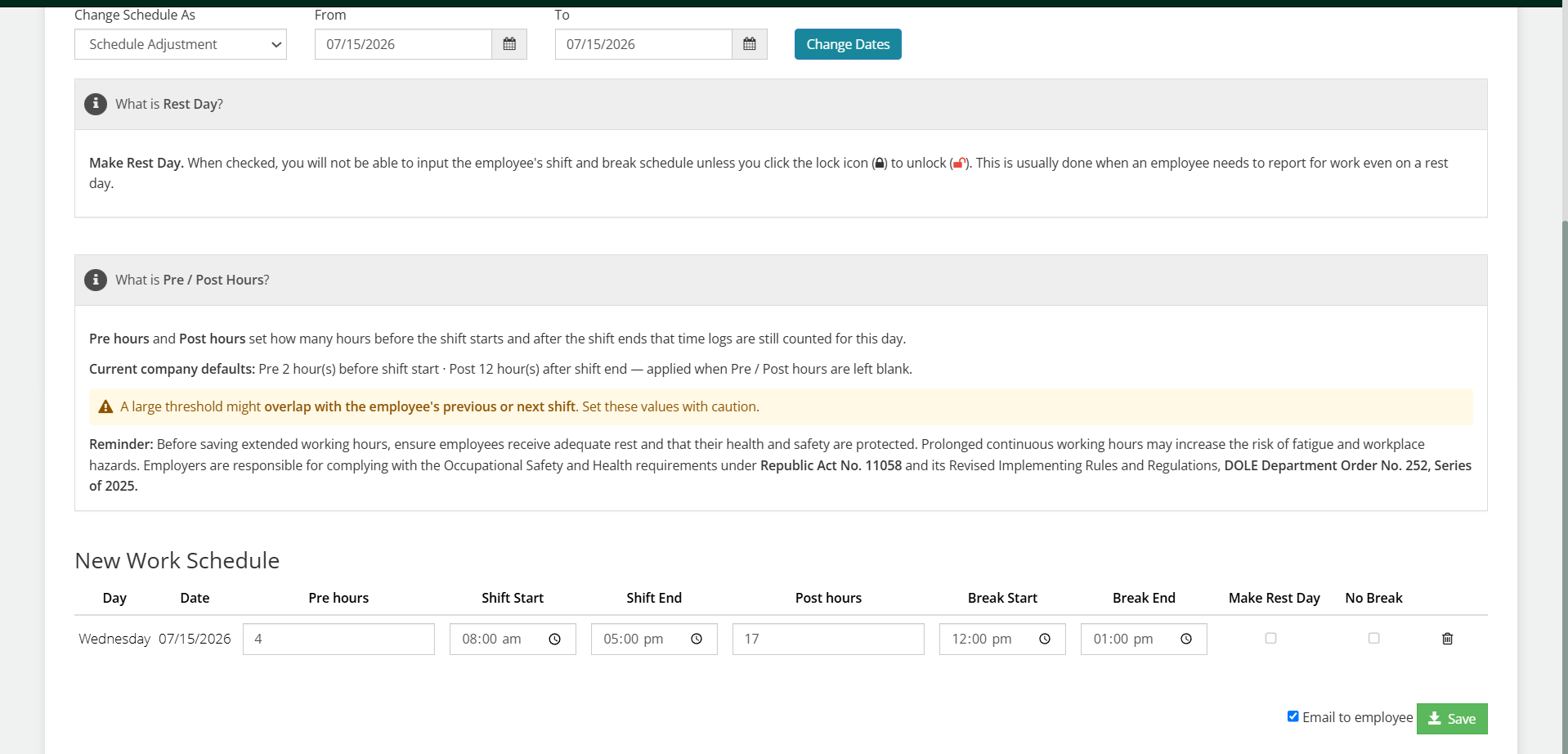
Schedule Adjustment — New Work Schedule, showing Pre hours = 4 and Post hours = 17
Step-by-Step: Setting Pre and Post Hours
- Navigate to Employee Profile > Work Information and click Change Schedule, or go to My Team > Manage Schedule.
- Set Change Schedule As to Schedule Adjustment.
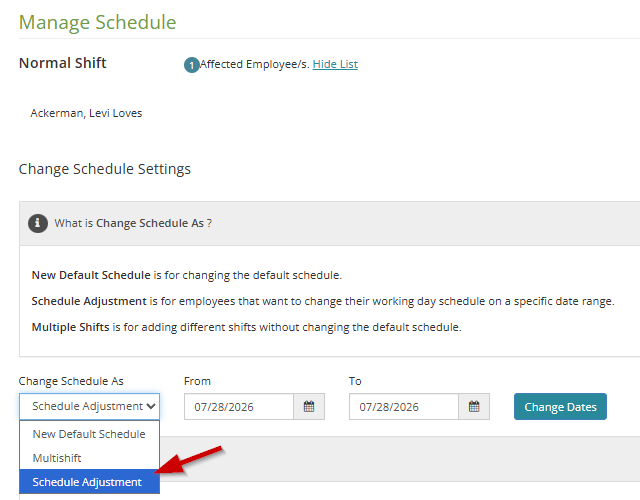
- Set the From and To dates for the schedule you want to adjust, then select Change Dates.
- In the New Work Schedule table, locate the row for the day you want to configure.
- Enter the Shift Start and Shift End times as usual.
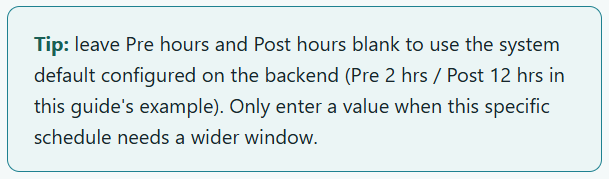
- In the Pre hours column, enter the number of hours before Shift Start that should still count toward this day (leave blank to use the system default, configured on the backend — 2 hours in this guide's example).
- In the Post hours column, enter the number of hours after Shift End that should still count toward this day (leave blank to use the system default, configured on the backend — 12 hours in this guide's example).
- Review the warning banner if either value is large — confirm it will not overlap the employee's previous or next shift.
- Select Save. Enable Email to employee if the employee should be notified of the schedule change.
Viewing Custom Thresholds: To view the existing custom pre- and post-shift thresholds for a specific date, set up a new Schedule Adjustment for that date. This will populate the configured values in the New Work Schedule table. Do not save the application if you only intend to view the settings.
Updating Custom Thresholds: If you want to update or edit those thresholds, you follow the same step-by-step procedure: create a new Schedule Adjustment for that specific date, enter the updated Pre hours and Post hours values in the table, and save it to overwrite the previous threshold configuration.
Schedule Precedence Rules (Date Tagging of Schedules): If a Date has an approved Schedule Adjustment, the specified shift in that Schedule Adjustment will rule. Regardless if there’s a specified Multiple Shift or New Default on the same Date, these schedules will be disregarded by Sprout HR. In case of a multiple Schedule Adjustment in the same Date, Sprout HR will refer to the latest saved Schedule Adjustment.
Field Reference
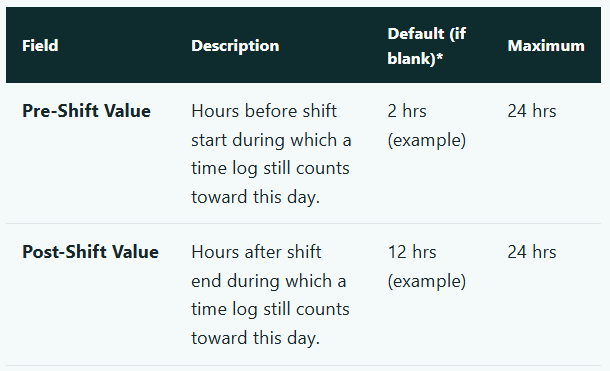
* Default (if blank): the fallback value applied when a field is left blank is configured on the backend and is not fixed by this feature. Pre 2 hrs / Post 12 hrs is the current example used throughout this guide — the actual fallback in your environment may differ.
Note: Minimum is 1 hour and 24 hours is the maximum value accepted in either field. Values above 24 are not accepted by the system.
Applicability
Supported Shift Types
Configurable Pre-Shift Value and Post-Shift Value are available for the following shift type only:
- Normal Shift
Shift types not listed above are not covered by this configuration and are out of scope for this guide.
Supported Employee Types
Configurable Pre-Shift Value and Post-Shift Value are available for the following employee types:
- Monthly / Semi-Monthly Employees
- Daily Paid Employees
Shift Basis: Standard and First Shift
For schedules on Standard Shift Basis and First Shift Basis, this feature does not change existing behavior — they remain as-is.
Holiday treatment for Standard and First Shift Basis is not affected or modified by this feature. This is noted here for clarity, not because anything changes: existing holiday pay rules continue to apply exactly as they did before.
How It Works
- A Manager, HR Administrator, or Super Admin sets Pre-Shift Value and/or Post-Shift Value for a schedule.
- The overtime-detection window extends to match the configured values instead of the default.
- Time logs that fall within the expanded window are computed as part of that shift day, including as overtime where applicable.
- Time that crosses midnight is attributed to the correct shift date automatically.
- The resulting hours flow through to payroll without manual adjustment.
In short: the effective ceiling adjusts to the configured thresholds — the system follows the schedule, not the default.
Important Notes and Safety Reminders
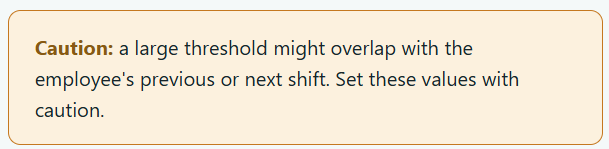
Reminder: Before saving extended working hours, ensure employees receive adequate rest and that their health and safety are protected. Prolonged continuous working hours may increase the risk of fatigue and workplace hazards. Employers are responsible for complying with the Occupational Safety and Health requirements under Republic Act No. 11058 and its Revised Implementing Rules and Regulations, DOLE Department Order No. 252, Series of 2025.
Related Control: Make Rest Day
When Make Rest Day is checked, shift and break inputs are locked unless the lock icon is toggled to unlock — used when an employee must report for work on a rest day. Pre-Shift Value and Post-Shift Value still govern how that day's time logs are counted, whether or not Make Rest Day is enabled.
Out of Scope
The following is not covered by this feature or this guide:
Want real-time responses? Explore Sidekick, your 24/7 guide for product inquiries!