
Overview
Sprout Comply is a compliance intelligence platform trained on Philippine labor law and regulatory requirements. It gives HR and payroll teams a single view of where a company stands on statutory compliance, flags risks before they become penalties, and prepares teams for DOLE inspections before they happen.
Sprout Comply is made up of five core modules: Dashboard, Payroll Audit, Policy Review, DOLE Inspection Simulator, and Compliance Calendar.
1. Dashboard
The Dashboard is the landing view of Sprout Comply — a single snapshot of overall compliance health.
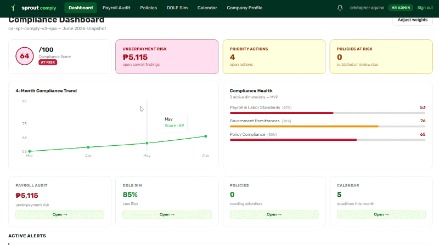
What it shows:
- Compliance Score (e.g., 64/100) with a risk label (e.g., "At Risk")
- Underpayment Risk — total peso exposure from open payroll findings
- Priority Actions — count of open items needing attention
- Policies at Risk — count of outdated or review-due policies
- 4-Month Compliance Trend — a line graph tracking the score over recent months
- Compliance Health breakdown across three weighted dimensions: Payroll & Labor Standards, Government Remittances, and Policy Compliance
- Quick-access summary cards for Payroll Audit, DOLE Sim, Policies, and Calendar, each with a direct link to that module
Purpose: Gives HR admins one place to see what's at risk and where to act next, without digging through each module individually.
2. Payroll Audit
Payroll Audit checks payroll data against statutory pay rules to catch underpayments before they become bigger liabilities.
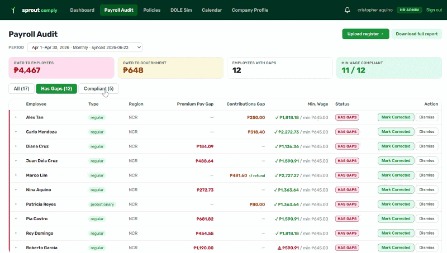
What it does:
- Checks every payroll row against 8 statutory rules
- Flags underpayments and government remittance gaps
- Summarizes exposure at the top level: amount owed to employees, amount owed to government, number of employees with gaps, and minimum wage compliance rate (e.g., 11/12 employees compliant)
- Lists flagged employees individually, showing type (regular/probationary), region, premium pay gap, contributions gap, and minimum wage comparison
- Each flagged row can be marked as Corrected or Dismissed
- Supports uploading a payroll register and downloading a full audit report
- Filterable by All, Has Gaps, or Compliant
Purpose: Surfaces underpayment and remittance risk at the individual employee level before it becomes back-pay owed or a penalty during a labor inspection.
3. Policy Review
Policy Review scans a company's HR policies against Philippine labor law to catch gaps before they're flagged externally.
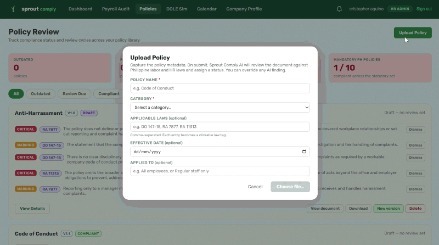
What it does:
- Accepts uploaded HR policies (e.g., Code of Conduct, Anti-Harassment Policy) with metadata: policy name, category, applicable laws, effective date, and scope (who it applies to)
- Sprout Comply's AI reviews the uploaded document against relevant PH labor laws and assigns a status (e.g., Compliant, Draft, Outdated)
- Flags specific gaps clause-by-clause — for example, missing reporting channels, undefined scope of coverage, or provisions that don't meet minimum legal requirements — each tagged with the relevant law or DOLE issuance (e.g., RA 7877, DO 147-15)
- Tracks a Mandatory PH Policies counter (e.g., 1/10 compliant against the statutory set)
- Findings can be overridden manually if the AI assessment needs correction
- Supports viewing, downloading, versioning, and deleting policy documents
Purpose: Ensures HR policy documentation stays current with PH labor law and that legally mandated policies aren't missing entirely.
4. DOLE Inspection Simulator
The DOLE Inspection Simulator lets a company self-audit against the same checklist a DOLE labor inspector would use — because DOLE inspections are unannounced.
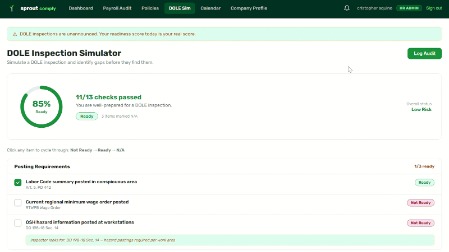
What it does:
- Presents a 16-item readiness checklist covering things like required postings (Labor Code summary, minimum wage order, OSH hazard information) and other inspection-standard items
- Each item can be toggled through three states: Not Ready → Ready → N/A
- Calculates an overall readiness percentage and risk level (e.g., 85% / Low Risk)
- Shows how many checks have passed (e.g., 11/13)
- Each item cites its legal basis (e.g., DO 198-18, Sec. 14) and explains what an inspector specifically looks for
- Includes a Log Audit function to record simulated inspection runs over time
Purpose: Turns DOLE compliance from a reactive scramble into a proactive, checklist-driven readiness process — so gaps are found internally, not by an inspector.
5. Compliance Calendar
The Compliance Calendar tracks every statutory deadline so filings and remittances don't get missed.
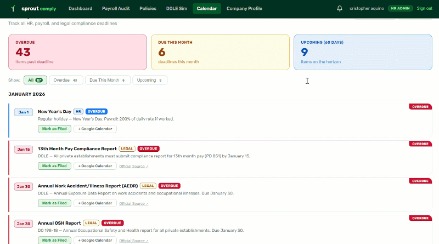
What it does:
- Tracks deadlines across categories like remittances, wage order changes, and DOLE reports
- Groups deadlines into Overdue, Due This Month, and Upcoming (60 Days), each with a running count
- Lists each deadline with its legal tag (e.g., HR, Legal), status (e.g., Overdue), a short description of the requirement, and its legal basis (e.g., 13th Month Pay Compliance Report — PD 851, due January 15)
- Each entry can be marked as filed or synced to Google Calendar
- Links out to the official source of the requirement where available
Purpose: Prevents statutory deadlines — remittances, mandatory reports, wage order updates — from being missed due to manual tracking.
Summary
| Module | Core Function |
|---|---|
| Dashboard | Single view of overall compliance score and risk |
| Payroll Audit | Flags payroll underpayments and remittance gaps against 8 statutory rules |
| Policy Review | Scans HR policies against PH labor law for gaps and missing mandatory policies |
| DOLE Inspection Simulator | 16-item self-audit checklist mirroring an actual DOLE inspection |
| Compliance Calendar | Tracks statutory filing and remittance deadlines |
Together, these modules move compliance management from reactive (finding out about a gap during an inspection or audit) to proactive (catching and correcting it internally, ahead of time).
Want real-time responses? Explore Sidekick, your 24/7 guide for product inquiries!